
When grief comes with a to-do list, even the simplest practical tasks can feel overwhelming.

This article is Part 3 of our Grief Awareness Month series, recognising NALAG Grief Support’s 2026 theme: Every Age. Every Loss. Every Story.
In Part 1 of this series, we looked at the many different forms grief can take and the ways loss can affect both mind and body.
In Part 2, we explored how to support someone who is grieving, including the value of practical help when ordinary tasks suddenly feel difficult.
But there is another side of grief that is talked about far less.
After someone dies, the people who loved them may be grieving deeply while also being expected to work out how that person’s life was organised.
- The bills do not stop.
- The pets still need feeding.
- Children still need routines and reassurance.
- Organisations need to be notified.
- Documents need to be found.
- Accounts need to be identified.
- Funeral decisions may need to be made.
And sometimes the only person who knew how everything worked is the person who has just died.
End-of-life planning cannot remove grief.
But it can prevent unnecessary confusion from being added to it
The Practical Side of Life Does Not Stop for Grief
Grief can affect concentration, memory, energy and the ability to manage ordinary everyday tasks.
Unfortunately, death can also create an immediate list of new responsibilities.
Depending on the person’s circumstances, family members or the person responsible for managing their affairs may suddenly need to:
- locate the Will and other important documents
- identify banks, insurance providers and superannuation funds
- notify government departments and other organisations
- work out which household bills need to continue
- cancel or transfer subscriptions and services
- locate funeral wishes or personal preferences
- make arrangements for children, pets or other dependants
- find important contacts
- identify online accounts and digital services
- understand what payments, memberships or renewals exist
- work out where important paperwork is stored
- deal with the person’s home, belongings and ongoing responsibilities
None of these tasks are unusual.
That is precisely the problem.
They are ordinary parts of somebody’s life that may have been managed quietly for years without anyone else needing to know how they worked.
When the Answers Lived in Someone Else’s Head
Every household develops its own invisible operating system.
- Someone knows when the electricity bill arrives.
- Someone knows which insurer covers the house.
- Someone knows where the birth certificates are.
- Someone knows which veterinarian looks after the dog, when the registration is due, which school contact to call, who services the car and which subscriptions are being automatically charged each month.
Often nobody deliberately decides that one person should hold all this information.
It simply happens.
Over years, people accumulate hundreds of small pieces of knowledge because they are the person who normally deals with them.
While that person is alive and well, this rarely seems like a problem.
After their death, those small pieces of information can become a succession of unanswered questions.

The Questions Families May Suddenly Face
- Which bank did they use?
- Was the funeral preference written down somewhere?
- Where is the insurance policy?
- Is that payment coming from a bank account or a credit card?
- Who needs to be contacted about the children?
- What happens with the pets?
- Was that account still being used?
- Where are the important documents?
- Who was their accountant?
- Did they have another superannuation fund?
One unanswered question may be manageable.
Dozens of them, arriving while someone is shocked, exhausted and grieving, can become an entirely different burden.
There Is Already a Lot to Do After Someone Dies
Australian government guidance reflects just how many practical matters can arise following a death.
Families may need to locate the person’s Will and important documents, consider funeral wishes, make arrangements for dependants, notify relevant organisations and begin dealing with the administration of the estate.
Organisations that may need to be contacted can include banks, insurers, superannuation funds, utilities, internet providers and government services.
The Australian Death Notification Service can make part of this process easier by allowing a person to notify multiple participating organisations through one service once the death has been registered.
But even useful services like this cannot tell a family what they do not know.
Knowing which organisations, accounts and memberships actually existed in the first place can still matter enormously.

Grief Should Not Have to Become a Detective Exercise
There is an important distinction between unavoidable responsibilities and avoidable confusion.
There will always be things to do after somebody dies.
End-of-life planning cannot eliminate the legal work involved in administering an estate. It cannot make telephone calls disappear or prevent organisations from requiring documentation.
What it can do is give the people handling those responsibilities somewhere to begin.
Instead of searching through drawers hoping to find an insurance policy, they can know where it is.
Instead of examining months of bank statements trying to identify household accounts, they can have a list.
Instead of asking several relatives whether anyone remembers what the person wanted for their funeral, they can read the wishes that were recorded.
Instead of trying to reconstruct a child’s routines, medical information or activities from memory, those details can already be documented.
The work may still need to be done.
The difference is that the person doing it is following information rather than trying to discover it.
Why This Matters to Me Personally
My own experience of losing my mum made the practical side of death impossible to ignore.
Grief does not arrive in a neat space where everything else politely waits until you are ready.
Life keeps moving.
There are still things that need attention, decisions that need to be made and responsibilities that cannot always be postponed.
Later, when I began thinking seriously about what would happen to my own children if something happened to me, another uncomfortable realisation followed.
I had a Will.
But a huge amount of the information my family would actually need was not in my Will.
It was in my head.
I knew how the household worked. I knew the bills, accounts, contacts, paperwork, routines, online information and all the countless small details that nobody else had ever needed to ask me about.
My Will dealt with my estate. It did not explain my life.
So I started writing that information down for my children.
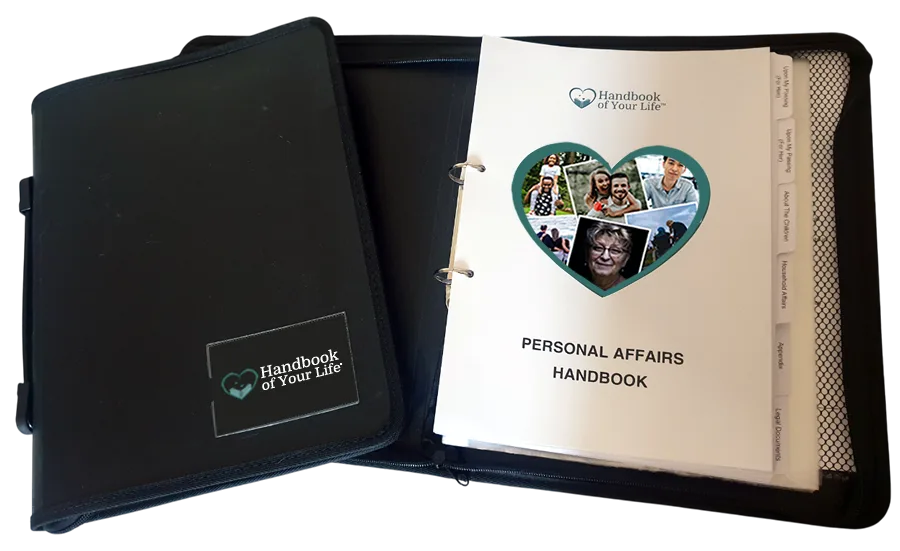
That process eventually became Handbook of Your Life.

The purpose was never to pretend that paperwork could somehow make losing someone easier.
It cannot.
The purpose was much simpler: if my children were ever grieving me, I did not want them spending that time unnecessarily searching for information I could have organised for them while I was here.
End-of-Life Planning Is More Than Preparing a Will
A Will is an essential part of planning, but it performs a particular legal purpose.
Practical end-of-life planning deals with another question:
What information would somebody need to understand and manage your everyday affairs if you were no longer here to explain them?
Important Documents
Where your Will, insurance policies, certificates, legal documents and other important records can be found.
Household Information
Utilities, regular bills, subscriptions, maintenance arrangements, vehicles, property information and other ongoing responsibilities.
Children and Dependants
Health information, routines, schools, activities, important people, preferences and practical information that can help somebody else provide continuity.
Pets
Veterinary details, registrations, medication, food, routines and care instructions.
Funeral and Personal Wishes
Preferences that may otherwise require family members to make decisions without knowing what you wanted.
Financial and Account Information
Enough information to identify the organisations and accounts that exist and allow the appropriate person to begin dealing with them.
Digital Information
The online accounts, services and digital assets that exist, together with appropriate instructions about where authorised access information can be found.
Preparing for death is not simply about deciding who receives your possessions.
It is also about recognising how much knowledge about your life may otherwise disappear with you.
Digital Information Needs Particular Care
Modern life has added another layer to this problem.
Many bills, statements, memberships and accounts now exist primarily online.
Someone may have several email addresses, cloud storage, social media accounts, subscription services, online banking, digital photographs and accounts that family members do not even know exist.
Documenting this information can be enormously helpful, but security still matters.
Practical planning does not mean writing every username and password together in one obvious place.
It means making sure the appropriate people can identify what exists and understand where authorised access information can be found when it is genuinely needed.
The aim is organisation without unnecessarily exposing sensitive information while you are alive.
You Do Not Need to Document Everything in One Weekend
One reason people put off end-of-life planning is that they imagine they need to sit down and completely catalogue their lives in a single heroic session.
They do not.
Start with the information that would cause the biggest problem if nobody could find it.
- Where is your Will?
- Who should be contacted first?
- What regular household accounts exist?
- Where are the important documents?
- What responsibilities do you manage for children, pets or another person?
- What would somebody struggle to work out without you?
Write those things down first.
Then add to them.
Practical end-of-life planning is far more useful when it is treated as an ongoing record of your life rather than a document completed once and forgotten.
Planning Cannot Remove Loss. It Can Remove Some of the Guesswork.
There is no form, folder or planning system that can make losing someone you love painless.
That is not what end-of-life planning is for.
Grief belongs to the relationship that existed.
The unnecessary confusion afterwards often belongs to information that did not.
We cannot spare the people we love from every difficult experience they may face after our death.
But we can choose not to leave them wondering where everything is.
- We can record the contacts.
- We can identify the accounts.
- We can write down the routines.
- We can explain our wishes.
- We can organise the important documents.
- We can leave information for loved ones while we are still here to provide it.
Sometimes caring for people in the future looks remarkably ordinary in the present.
It looks like writing things down.
Make the Practical Side Easier for the People You Love
The Handbook of Your Life end-of-life planning system is designed to help you organise the personal and practical information your loved ones may one day need, alongside rather than in place of your legal planning.
Make the practical side easier for the people you love.
Explore the Handbook of Your Life end-of-life planning system →
View our Handbook range to see what fits best with your situation and life circumstances →