
Getting organised should make information easier to find without making it easier for the wrong person to use.
End-of-life planning often begins with a sensible goal: gather the information your family may need and put it somewhere they can find it.
That information may include bank accounts, insurance policies, household services, digital accounts, important contacts, legal documents and instructions for children, pets or other dependants.
The problem is not the act of getting organised. The problem is what can happen when identifying information, passwords and other sensitive access details are all stored together.
A notebook, folder, box of files or digital account may be convenient for you and your loved ones. But if one person can find everything in one place, so can someone who was never meant to see it.
That creates what we call a single point of exposure.
Why the “One Safe Place” Approach Feels Sensible
Most people have been told to keep their important information in one safe place.
On the surface, that advice makes perfect sense. Your family should not have to search through drawers, cupboards, devices and filing cabinets during an emergency or after your death.
Bringing information together can make end-of-life planning more useful. It helps a trusted person understand what exists, what needs attention and where important documents can be found.
The difficulty begins when “one organised place” becomes “one place containing everything needed for access”.
There is an important difference between documenting that a bank account exists and recording the bank, account number, username, password, security answers and two-factor authentication details together.
The first helps your loved ones identify and manage an account.
The second may provide almost everything another person needs to attempt to access it.
What Is a Single Point of Exposure?
A single point of exposure exists when one discovery, theft or unauthorised viewing reveals a large amount of sensitive information at once.
For example, someone who finds an end-of-life planning folder may learn which bank you use, which email address is connected to the account and where your passwords are recorded.
Even where no single page contains every detail, keeping all related information in the same folder, box, drawer or digital account can allow the pieces to be connected.
This does not mean physical organisers or digital vaults are automatically insecure. It means the security of any system depends on what information it contains, how that information is protected and whether one successful point of access reveals too much.
No system can remove every possible risk. A practical security system should instead reduce the amount of useful information exposed through any one document, location or login.

How End-of-Life Planning Products Protect Sensitive Information
Different products take very different approaches to end-of-life planning security.
Understanding those approaches can help you choose a system that suits your household, your technical confidence and the type of information you intend to record.
Physical Organisers, Folders and Boxes
Physical end-of-life organisers are easy to understand and do not depend on technology. A trusted person can open the organiser, follow the sections and locate documents without needing an app or online account.
Their security depends heavily on what the owner places inside them and where they are stored.
Some physical organisers advise users not to store every password or original document in the same box. They may recommend keeping certain records elsewhere or using the organiser as an index showing where information can be found.
That advice can reduce exposure, but the customer still needs to create and maintain their own method for separating sensitive access information.
A locked drawer, cabinet or home safe may help protect the organiser from casual access. However, physical security alone does not address what happens if the container is opened, stolen or accessed by someone who should not have it.
Encrypted Digital Vaults
Digital legacy and end-of-life planning platforms commonly protect information through encryption, passwords, multi-factor authentication and controlled sharing.
These services can be convenient, particularly for people who already manage most of their affairs online. Information can often be updated from different devices and shared with nominated people under selected access permissions.
The security model relies on protecting the digital account rather than physically separating the information.
Customers should understand what happens if they lose their login details, cannot access their device, stop paying for the service or the provider changes or closes in the future.
They should also consider whether their nominated person will have the technical confidence and legal authority required to access and use the information when needed.
Password Managers and Emergency Access
Password managers are specifically designed to store and protect login credentials. Many use encryption and allow an account holder to nominate a trusted emergency contact.
They can be an effective way to avoid writing passwords throughout an end-of-life planning folder.
However, a password manager usually stores credentials rather than the complete practical context your family may need.
A trusted person may gain access to a list of accounts and passwords but still need instructions explaining which services matter, what bills must be paid, which accounts should be closed and how the wider household operates.
Password managers can therefore complement end-of-life planning, but they do not replace the need for clear personal and practical guidance.
Split-Information and Multi-Part Systems
Some specialised security systems divide access information into separate parts.
This principle is used in areas such as cryptocurrency recovery, where a recovery secret can be divided into multiple shares and a set number of shares is required before access can be restored.
The underlying idea is straightforward: one part alone should not reveal the complete information.
A split-information approach can also be applied to practical end-of-life planning without requiring advanced technology. Identifying account information can be documented in one place, while sensitive access details are recorded elsewhere.
The effectiveness of this approach depends on clear instructions, responsible document storage and ensuring a trusted person knows that the separate components exist.
Security Must Be Balanced with Accessibility
The most secure document in the world is useless to your family if nobody knows it exists or nobody can access it when genuinely needed.
End-of-life planning security therefore requires a balance between protection and accessibility.
Sensitive information should not be casually available, but the system should not be so complicated that a trusted person cannot understand it during an emergency, illness or period of grief.
A practical system should answer four questions:
1. What information is being recorded?
There is a difference between identifying an account and recording everything needed to access it.
Your end-of-life planning system should make that distinction clear.
2. What could someone learn from one document?
Consider what would be exposed if someone found only your main handbook, only your password record or only your supporting information.
One document should not unnecessarily reveal the complete picture.
3. Where will each document be stored?
Telling users to “keep this secure” is not a complete storage plan.
Documents should be assigned separate locations where required, and those locations should be reviewed whenever you move house or change who you trust.
4. Will the right person know what to do?
At least one nominated person should know that your end-of-life planning system exists and understand where the necessary documents can be found.
They do not necessarily need immediate access to every document while you are capable of managing your own affairs.
How 2DocLock™ Approaches the Single-Exposure Problem
The 2DocLock™ Security System is included with every Handbook of Your Life® kit.
It is an optional, completely offline system designed to keep passwords and sensitive access information out of the main handbook.
Rather than relying only on a locked binder, app or online vault, 2DocLock™ combines two protocols: the Integrated Codes System Protocol and the Document Separation Protocol.
The Integrated Codes System Protocol
The Integrated Codes System Protocol controls how sensitive access information is recorded.
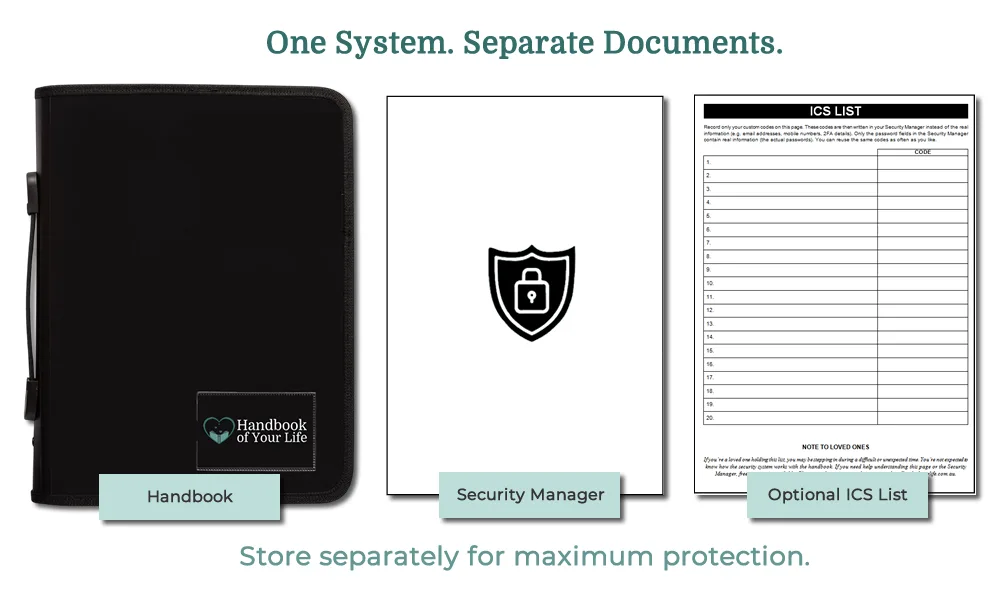
Under the Essential Method, passwords and other sensitive access details are kept out of the Handbook and recorded in a separate document called the Security Manager.
The Enhanced Method builds on this by using the optional ICS List to code information such as usernames, email addresses and two-factor authentication details.
This creates an additional information layer. The Handbook provides the context, the Security Manager contains the relevant access entries and the ICS List assists with decoding selected information.
Customers can choose the method that best suits their circumstances and comfort level.
The Document Separation Protocol
Coding information achieves little if all related documents are then stored together.
The Document Separation Protocol is therefore an essential part of the system.
At a minimum, the Handbook and Security Manager should be kept in separate locations.
For maximum protection under the Enhanced Method, the Handbook, Security Manager and optional ICS List should each be stored separately.
Where three locations are not practical, the ICS List may be stored with another document. Keeping it with the Handbook is the preferred reduced-protection option, while the Security Manager containing the actual passwords remains elsewhere.
A trusted nominee should know that the system exists and where the documents can be found when access is genuinely required.
No App, Cloud Account or Subscription
2DocLock™ does not require an app, online account, cloud storage or ongoing subscription.
Nothing is uploaded to a third-party server as part of the system.
This makes it suitable for people who prefer paper-based organisation, have limited confidence with technology or simply do not want their end-of-life planning information stored online.
Free step-by-step video guides are available to customers through the Customer Resources Portal. These demonstrate the Essential and Enhanced methods in real time and explain how to set up and store the documents correctly.
No Security System Removes Every Risk
The aim is not to create an impenetrable puzzle that nobody can solve.
The aim is to prevent one misplaced folder, one stolen box or one exposed document from unnecessarily revealing everything.
Questions to Ask Before Choosing an End-of-Life Planning System
Before recording sensitive personal information, ask how the system deals with the following:
- Does it encourage passwords to be stored beside account names and identifying details?
- Would finding one folder, box, device or login reveal most of the information?
- Can sensitive access details be kept separate while still being available to a trusted person?
- Does the system rely on an ongoing subscription, third-party service or internet access?
- Could your nominated person understand how to use it during an emergency or after your death?
- Can the information be updated without rebuilding the entire system?
- Does the product provide clear security guidance, or does it simply tell you to store everything somewhere secure?
A well-designed end-of-life planning product should help you answer these questions before you begin filling it in, not after every password has already been written beside every account.
Summary: Organise for Access, Not Exposure
End-of-life planning should help your family find the information they need without creating an unnecessarily complete package for anyone who happens to find it.
Physical organisers, digital vaults and password managers can all play a useful role. Each uses a different security model and each carries different responsibilities for the person using it.
The key is to separate organisation from unrestricted access.
Your family may need to know that an account, document or service exists. That does not mean every password, PIN and authentication detail needs to sit beside it.
2DocLock™ was designed around that distinction.
By combining coded information with structured document separation, it allows sensitive access details to remain available to the right person without storing the entire picture in one place.