
Safe Work Month is about more than getting through a shift.

October is National Safe Work Month across Australia. In 2026, the campaign theme is “Safe work is for life” – a reminder that work health and safety is not only about preventing harm in the moment. It is about protecting a worker’s life, health and future.
That message also reaches beyond the workplace. When a serious injury or work-related illness occurs, the effects can follow a person home. A partner may suddenly become a carer. Children may need different routines. Household responsibilities can shift overnight. Income, transport, appointments, medication, rehabilitation and paperwork can all demand attention at the same time.
Safe Work Australia reports that 188 workers were fatally injured at work in 2024. In 2023-24 there were 146,700 serious workers’ compensation claims involving at least one week of working time lost – more than 400 serious claims every day across Australia.
Every number represents a person whose ordinary life was interrupted. It can also represent a household trying to work out what happens next.
The consequences do not clock off when work ends
A workplace incident can create two problems at once. The first is the injury or illness itself. The second is everything that person normally manages outside work.
- Who pays the household bills if they are in hospital or unable to manage online accounts?
- Who knows the children’s school contacts, routines, medications or activity schedules?
- Who can explain existing health conditions, allergies, medicines and healthcare providers?
- Who looks after pets, caring responsibilities or an older family member?
- Who keeps track of appointments, certificates, treatment notes and insurance or workers’ compensation paperwork?
- Who knows where important documents are kept if decisions need to be made quickly?
These are not workplace safety questions. They are household continuity questions – and they often become urgent only after something has already happened.

Prevention first. Preparedness second.
The first priority is always preventing workplace harm. Employers and workers have responsibilities under work health and safety laws, and National Safe Work Month exists to strengthen that prevention culture.
Preparedness serves a different purpose. It asks: if prevention fails and life changes suddenly, can the people around you find the information they need to keep things moving?
That is where health event preparedness fits. It does not replace an employer’s WHS duties, a workers’ compensation claim, medical treatment or a rehabilitation plan. It supports the practical side of life outside those systems.
What would someone need to know tomorrow?
A useful way to test your preparedness is to imagine you could not manage your normal responsibilities for one week. What would another person need to know on the first day?
- your key contacts and Nominated Person
- current medications, allergies, conditions and Practitioners / Healthcare Providers
- children’s or dependants’ routines, schooling and care information
- essential household bills, service providers and recurring responsibilities
- insurance and claim-related information relevant to the event
- where important legal and identification documents are stored
- how to contact people involved in caring, household or business responsibilities
The aim is not to create a second job for yourself. It is to remove avoidable guesswork if someone else has to step in.
How health event preparedness differs from end-of-life planning
Health event preparedness and end-of-life planning overlap, but they are not the same thing.
Health event preparedness is designed for accidents, surgery, serious illness, treatment, rehabilitation and periods when someone may be temporarily or permanently unable to manage normal life. The focus is immediate care, communication, household continuity and recovery.
End-of-life planning prepares for death and the practical, personal and legal matters that loved ones may need to manage afterwards. It also includes planning for serious incapacity through appropriate legal and advance care documents.
The shared principle is simple: important information should not exist only in one person’s head.
Where Handbook of Your Life fits
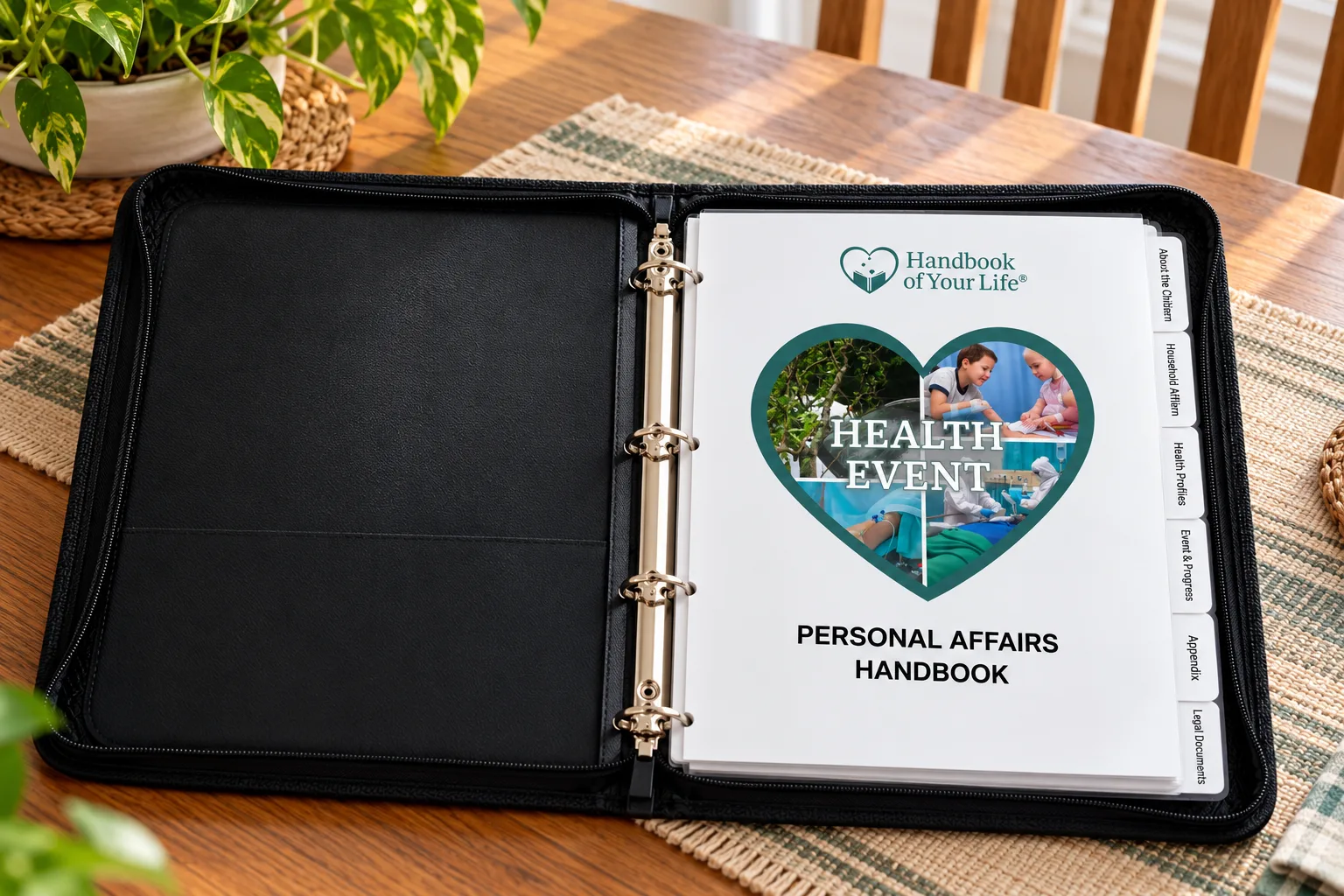
The Health Event Handbook Kit is designed for the period when illness, injury or treatment disrupts ordinary life. It brings health profiles, household information, children’s needs, contacts, key documents and event tracking together so a trusted person can step in without rebuilding everything from memory.
For someone who only needs to track a particular injury, illness or treatment period, the Event Tracking Module can be used as a standalone record or added to an existing handbook.
That is the practical connection between Safe Work Month and planning ahead. Workplace safety aims to stop harm before it happens. Health event preparedness helps the person and household function if life is disrupted anyway.
Use Safe Work Month as a prompt to prepare beyond the workplace
National Safe Work Month is rightly focused on preventing work-related injury, illness and death. But its 2026 message – Safe work is for life – is also a reminder that the consequences of harm reach into families, homes and futures.
This October, talk about hazards at work. Review what can be prevented. Then ask one extra question at home: if something happened to me tomorrow, would the people I rely on know what they need to do?
A little organisation before a crisis can make the practical side of an already difficult situation far easier to manage.
Frequently Asked Questions
Important Information
This article is provided for general information and educational purposes only. It does not constitute legal, financial, medical or other professional advice.
Information, statistics, legislation and external resources may change after publication. Readers are encouraged to verify information with current, authoritative sources, conduct their own research and seek qualified professional advice where appropriate.